 December 5, 2025
 11 min read
OCR vs Manual Data Entry is the ultimate technology showdown for businesses aiming to scale in the modern digital era. While the dream of a “paperless office” has existed for decades, many firms are still drowning in PDFs and physical documents. In 2024, the ability to process information rapidly is a competitive necessity. To grow, business leaders must decide between the traditional human touch and the high-speed precision of machine intelligence.
In this comprehensive guide, we will compare OCR vs Manual Data Entry across five critical metrics to help you choose the most efficient path for your company’s digital transformation.
1. Speed and Turnaround Time: Machines vs. Humans
In the OCR vs Manual Data Entry race, speed is the most obvious differentiator. A professional typist can process 40-60 words per minute, but this speed is limited by human biology. Fatigue, distractions, and the need for breaks eventually slow down even the most experienced employees.
On the other hand, AI-powered engines like pdftoexcelconverter.ai can process thousands of pages per minute. When you need to automate Excel input, software is the only solution that works 24/7 without interruption. For a high-volume logistics or finance firm, what takes a human team a week to finish can be completed by an AI OCR tool in just a few seconds.
2. Accuracy and Human Error Rates
Accuracy is a major battleground in the OCR vs Manual Data Entry debate. Manual entry is prone to “fat-finger” errors—small typos in numbers or names that can lead to massive financial discrepancies. Industry standards suggest that human error rates typically fall between 1% and 4%.
Modern AI-driven OCR has revolutionized this metric. Today’s software can achieve over 99% accuracy on printed text. Unlike traditional OCR that only matched shapes, modern data extraction software uses deep learning to understand context. For instance, if an image is slightly blurry, the AI can “guess” the correct character based on the surrounding words, ensuring a level of consistency that manual entry cannot guarantee.
3. Cost Efficiency and Long-Term ROI
The financial impact of choosing OCR vs Manual Data Entry is massive for any growing business. Manual entry involves high recurring operational costs: salaries, health benefits, office space, and the time spent on recruitment and training. These costs increase linearly as your business grows.
In contrast, choosing an AI OCR platform allows for a lower and highly predictable cost structure. You typically pay for what you use (per page or a monthly subscription). Most businesses see a significant Return on Investment (ROI) within just a few months of switching to an automated system, as they stop paying for “typing hours” and start paying for “verified data.”
4. Scalability: Growing Without Growing Pains
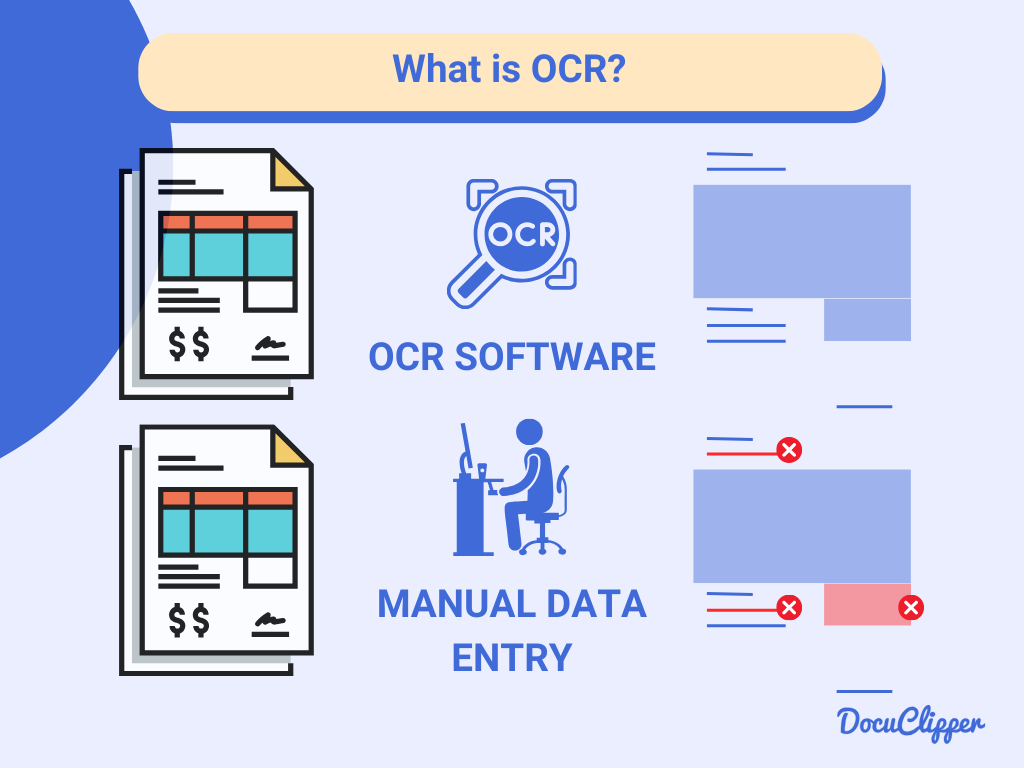
Scalability is the biggest differentiator in OCR vs Manual Data Entry. Manual entry scales poorly. If your workload suddenly doubles, you must hire twice as many people—a process that takes weeks of interviewing and training.
OCR vs Manual Data Entry scalability heavily favors technology. Cloud-based AI systems can handle a spike of 10,000 invoices on a Monday morning just as easily as they handle ten files. This ability to automate Excel input at scale allows your business to grow without the friction of administrative bottlenecks.
5. Security, Privacy, and Compliance
In the modern world, data security is non-negotiable. In the OCR vs Manual Data Entry debate, manual entry poses significant privacy risks. Sensitive financial or personal data is exposed to human eyes, and physical papers can be lost, stolen, or left on a desk.
Using the advanced OCR at pdftoexcelconverter.ai allows for encrypted processing. The data moves from the image to your database without any human ever seeing the contents. Furthermore, digital systems create an automated audit trail—you know exactly when and how every piece of data was processed, which is essential for GDPR or HIPAA compliance .
The Hybrid Winner: Human-in-the-Loop (HITL)
The most successful modern companies don’t always choose one over the other. Instead, they use a hybrid model called “Human-in-the-Loop.” In this workflow, the AI handles 95% of the “heavy lifting” automatically. A human reviewer only steps in to validate “low-confidence” scans—such as a particularly messy handwritten note or a very low-resolution photo. This synergy provides the speed of AI with the final judgment of a human expert.
Industry-Specific Use Cases
-
Banking: Using OCR to scan ID cards for instant eKYC onboarding.
-
Logistics: Automating the extraction of data from Bills of Lading and shipping manifests.
-
Retail: Converting supplier invoices into structured Excel sheets for inventory tracking.
Frequently Asked Questions (FAQ)
Which is more expensive: OCR or Manual Entry?
Initially, manual entry might seem cheaper for very low volumes. However, for any business looking to scale, OCR vs Manual Data Entry math favors software due to lower recurring costs and fewer errors.
Can OCR read handwriting better than a human?
Generally, no. Humans still have a slight edge in reading messy handwriting, but AI-powered data extraction software is rapidly closing the gap with deep learning models.
How do I automate my Excel input?
The fastest way is to use a dedicated platform like pdftoexcelconverter.ai, which specializes in converting unstructured PDFs and images into structured Excel files instantly.
Conclusion: Which Strategy Wins for Your Business?
Manual entry is a legacy method that often holds businesses back from their full potential. In the battle of OCR vs Manual Data Entry, technology is the clear winner for firms aiming for rapid growth, high efficiency, and data security.
By replacing manual typing with the AI-powered tools at pdftoexcelconverter.ai, you free your team to focus on strategic, high-value work instead of mundane data entry.